
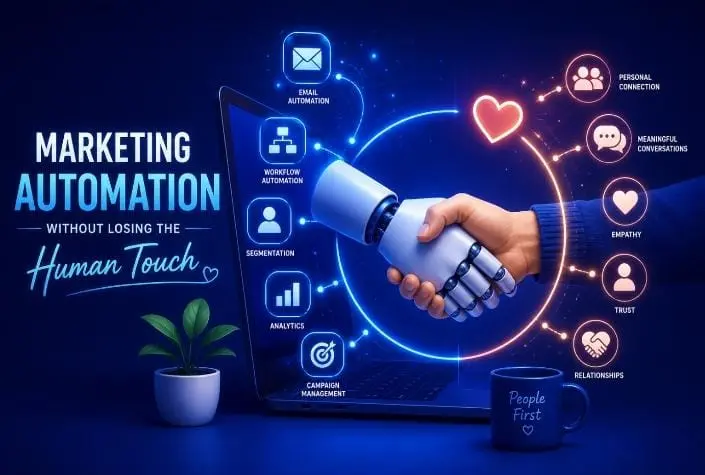
Marketing Automation Without Losing the Human Touch
A few years ago, “automation” felt like a superpower. Set up the workflow once, and it runs forever — emails send themselves, leads get nurtured while you sleep, reports build themselves before your Monday meeting. It felt like getting time back. Marketing Automation But somewhere along the way, a lot of brands took that gift and used it to do the wrong thing faster. Instead of freeing people up for better marketing, automation became an excuse to skip the thinking part. Send the same email to everyone. Slap a first name in the subject line and call it personal. Let the chatbot handle it, even when what the customer really needed was a person who could just… listen. And customers can tell. You can tell, too — you’ve gotten those emails.Marketing Automation The ones that technically use your name but feel like they were written for nobody in particular. That’s not personalization. That’s a form letter with a mail-merge. So here’s the real question worth sitting with: not “how do we automate more,” but “what actually deserves a human, and what doesn’t?”
The Problem Was Never Automation Itself
Automation gets blamed for feeling cold, but that’s not really automation’s fault — it’s what happens when automation replaces judgment instead of supporting it.Marketing Automation. A tool that sends the same three follow-up emails to a brand-new visitor and a five-year loyal customer isn’t being efficient. It’s just not paying attention.The point was never to get humans out of marketing. It’s to get humans out of the parts that were never a good use of their time in the first place — so there’s more energy left for the parts that actually need a person.
What Automation Is Genuinely Good At
Some things really are better left to a system. Not because people can’t do them, but because a machine does them faster, more consistently, and without getting tired or forgetting a step:
– **Reacting to real behavior** — someone abandons a cart, opens an email three times, or hasn’t logged in for two months. A system can notice and respond instantly. A person checking a spreadsheet every morning can’t.
– **Sorting people into groups that make sense** — new visitor vs. loyal customer, browser vs. buyer. Nobody wants to do that sorting by hand across ten thousand contacts.
– **The unglamorous stuff** — scheduling posts, tracking A/B tests, pulling weekly reports. Nobody’s creativity was ever sparked by building a pivot table.
– **The first touch** — a chatbot that answers “what are your hours” or points someone to the right page. Fine.Marketing Automation Just make sure there’s a fast, easy way out to a real person the moment things get more complicated than that.
What Still Needs an Actual Person
Some moments matter too much to hand off completely:
A frustrated customer An automated reply to someone who’s already upset usually makes things worse, not better. A big sale.Enterprise deals, custom pricing, anything that hinges on trust that’s relationship work, not workflow work.
Public conversation.Replies to comments, reviews, DMs — anywhere your brand’s voice is visible, it should actually sound like someone wrote it. nything representing your brand publicly.** Automation can draft. A person should always be the one who hits publish. Here’s a simple test: if a customer would feel a little let down to find out a bot handled that moment, it needed a person.
The Bottom Line
Automation isn’t what makes marketing feel fake. Lazy automation is. Done well, it should make your brand feel more human, not less — because it clears out the busywork so the people on your team can actually spend their time on the moments that need them.
So don’t start with “how do we automate this?” Start with “does automating this make the human parts better, or does it just make them disappear?” Get that answer right, and the human touch mostly takes care of itself.