
How to Build a Successful Digital Marketing Strategy from Scratch: A Step-by-Step Guide for Beginners and Growing Businesses
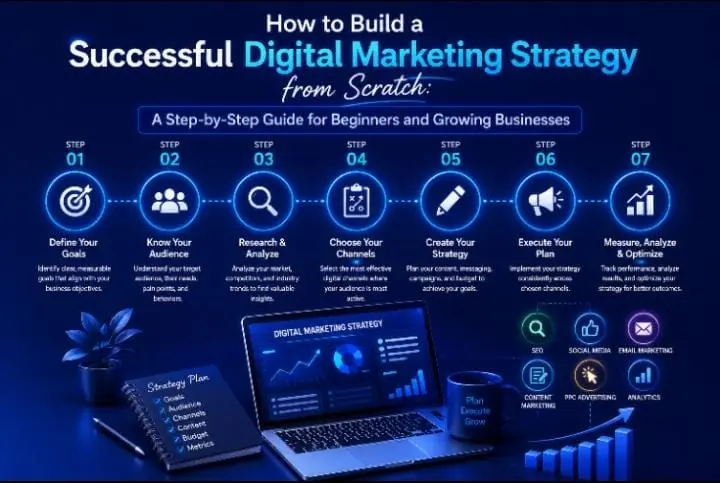
best Digital Marketing Strategy Starting a digital marketing strategy can feel like standing at the bottom of a very tall staircase with no idea which step to take first. You have probably heard terms like SEO, PPC, content marketing, and social media thrown around in every business conversation, and maybe you have nodded along while secretly wondering what any of it actually means in practice.
Here is the honest truth: most businesses that struggle with digital marketing do not fail because they lack budget or talent. best Digital Marketing Strategy They fail because they start without a clear plan. They pick a channel, throw some money at it, wait a few weeks, see little results, and then either give up or jump to the next shiny tactic.
This guide is written to help you avoid that cycle. Whether you are starting from absolute zero or trying to bring some structure to scattered marketing efforts, this step-by-step breakdown will walk you through everything you need to know, in plain language, with practical direction at every stage.
1. Understanding the Foundation of Digital Marketing
Before you spend a single dollar or publish a single post, it helps to understand what you are actually working with. Digital marketing is not just one thing. It is a collection of connected activities, and understanding how they relate to each other makes every decision easier down the road.
a) What Digital Marketing Actually Means and Why It Matters Today
Digital marketing refers to any marketing activity that happens through digital channels, which basically means anything online or through electronic devices. This includes websites, search engines, social media platforms, email, mobile apps, and paid advertising across all of those spaces.
The reason it matters so much right now comes down to where people spend their time and how they make decisions. According to DataReportal’s 2024 Global Digital Overview, over 5.3 billion people use the internet worldwide, and the average person spends roughly six and a half hours online every day. When your potential customers are trying to solve a problem, find a service, or compare options, they are doing it online. best Digital Marketing Strategy If your business is not visible in those moments, you are invisible to them.
What makes digital marketing genuinely useful for smaller businesses is the level of control it gives you. Unlike traditional advertising, where you print a flyer and hope the right person sees it, digital marketing lets you target specific audiences, track every click and conversion, and adjust your approach based on actual results rather than guesswork.
Digital marketing gives you the ability to reach the right people, measure what is working, and change what is not, all without committing your entire budget to something you cannot evaluate.
.
b) How Digital Marketing Differs From Traditional Marketing Approaches
Traditional marketing covers things like newspaper ads, TV commercials, radio spots, billboards, and direct mail. These methods can still work, but they come with real limitations: they are expensive, difficult to target precisely, and nearly impossible to measure with any accuracy.
If you run a full-page ad in a local magazine, you might reach 10,000 readers. But you have no idea how many of those readers are actually interested in what you sell, how many saw the ad versus skipped past it, or whether anyone who saw it actually contacted you because of it.
Digital marketing changes that dynamic completely. When someone clicks your Google ad, you know exactly which keyword triggered it, how long they stayed on your page, and whether they completed a purchase or filled out a contact form. That data feedback loop is what makes digital marketing so much more efficient over time.
Another important difference is cost. A small business can run a highly targeted Facebook ad campaign for as little as five dollars a day. That same business would need thousands of dollars to run even a modest print or TV campaign. est Digital Marketing Strategy The accessibility gap is significant, and it is one of the main reasons digital marketing has become the default choice for businesses of every size.
c) Key Components That Make Up a Complete Digital Marketing Ecosystem
Think of digital marketing as an ecosystem rather than a single activity. The components include:
- Website and landing pages: Your digital home base where everything else directs traffic
- Search Engine Optimization (SEO): The process of making your site visible in organic search results
- Content marketing: Creating useful, relevant material that attracts and educates your audience
- Social media marketing: Building relationships and visibility on platforms where your audience spends time
- Email marketing: Communicating directly with people who have shown interest in your business
- Paid advertising: Buying visibility through platforms like Google Ads, Facebook Ads, or LinkedIn Ads
- Analytics and tracking: Measuring what all of these activities are actually producing
.
None of these components works in complete isolation. Your content supports your SEO. Your SEO drives traffic to your website. Your website captures email subscribers. Your email campaigns bring people back. They all feed each other, and that interconnected structure is what makes a strategy different from just doing random marketing tasks.
2. Setting Clear Goals and Identifying Your Target Audience
Every practical decision in your digital marketing strategy flows from two things: knowing what you are trying to achieve and knowing who you are trying to reach. Without both of those, you are essentially navigating without a map.
a) How to Define Realistic and Measurable Marketing Goals Using the SMART Framework
The SMART framework is a simple structure for writing goals that are specific enough to work toward. SMART stands for:
- Specific: The goal is clearly defined, not vague
- Measurable: You can track progress with actual numbers
- Achievable: The goal is realistic given your resources and timeline
- Relevant: It connects directly to your broader business objectives
- Time-bound: There is a clear deadline attached to it
A vague goal sounds like: “We want more website traffic.” A SMART goal sounds like: “We want to increase organic website traffic by 30% over the next six months by publishing two blog posts per week and optimizing our existing top-ten pages.”
The difference matters because the second version tells you what to do, how to measure it, and when to evaluate whether it worked.
When you are setting your initial goals, try to cover different stages of growth. You might set goals around brand awareness, lead generation, website traffic, email list growth, or direct sales, depending on where your business currently stands. A brand-new business will prioritize awareness and traffic. An established one might focus more on conversion rates and customer retention.
If you cannot measure it, you cannot improve it. Write goals that give you something concrete to track, not just something to aim at generally.
b) How to Research and Build Detailed Customer Profiles (Buyer Personas)
A buyer persona is a detailed, semi-fictional description of your ideal customer. It goes far beyond basic demographics like age and location. A useful persona captures how your ideal customer thinks, what problems they are trying to solve, what they read, which platforms they use, and what objections or hesitations they might have before buying from you.
Here is how to build one from scratch:
Start with what you already know. If you have existing customers, look at who your best ones are. What do they have in common? What problems were they dealing with when they found you?
Talk to real people. There is no substitute for actual conversations. Short interviews with five to ten customers or potential customers can reveal insights that no amount of internal brainstorming will produce.
Use available research tools. Google Analytics shows you data about who is already visiting your site. Social media platform insights show you audience demographics. Free tools like Answer the Public or even Reddit threads in your industry can tell you what questions people are actively asking.
Build the profile. Give your persona a name, a job title, a general income range, and a clear description of their daily challenges and what they hope to achieve. Include where they get their information, what frustrates them about current solutions, and what a perfect outcome looks like for them.
A persona named “Sarah, a 38-year-old small business owner who is overwhelmed trying to manage marketing herself and wants something practical and affordable” is far more useful than “women aged 30 to 45.”
c) How to Align Your Business Objectives With the Right Audience Segments
Once you have your goals and your personas, the next step is making sure they actually connect. Different audience segments often respond to completely different messages, platforms, and types of content.
For example, if your business goal is to increase online sales by 25% this quarter and your target audience is time-pressed small business owners, your strategy should focus on channels those business owners actually use (likely LinkedIn, Google Search, or email), with messaging that speaks directly to saving time or reducing stress rather than offering the most affordable option.
Misalignment between goals and audience is one of the most common problems I see in early-stage marketing plans. A business will set a revenue goal but then run Instagram campaigns targeting a very broad audience with no real connection to the product. The platforms and messages need to match who you are actually trying to reach and what you want them to do.
3. Choosing the Right Digital Marketing Channels for Your Business
With so many channels available, the challenge is not finding options. The challenge is choosing the right ones without trying to do everything at once, which almost always leads to doing nothing particularly well.
a) Overview of Major Digital Channels: Search, Social Media, Email, and Paid Advertising
Here is a plain-language overview of the main channels:
Search (SEO and Google): When someone types a question into Google, the results they see are driven by SEO (organic results) or paid search ads. Ranking organically takes time but produces long-term, cost-effective traffic. Paid search can deliver immediate visibility but requires an ongoing budget.
Social Media: Platforms like Facebook, Instagram, LinkedIn, TikTok, Pinterest, and X (formerly Twitter) each serve different audiences and content types. Social media is effective for building brand awareness, community, and trust over time.
Email Marketing: One of the most cost-effective digital channels available. Once you build a list, you own direct access to those people without depending on a platform’s algorithm. Email is particularly strong for nurturing leads and retaining existing customers.
Paid Advertising: Covers social media ads, display ads, and paid search. Paid channels let you scale visibility quickly and target very specific audiences. The tradeoff is that results stop when your budget stops.
Content Marketing: This one overlaps with all the others. Blog posts, videos, podcasts, guides, and case studies are content. The goal is to attract and educate your audience rather than directly pitch to them.
b) How to Evaluate Which Channels Best Match Your Audience Behavior and Budget
Choosing a channel should start with a simple question: where does my target audience actually spend their time, and how do they prefer to receive information?
A B2B software company targeting senior executives will likely find more traction on LinkedIn and through email than on TikTok. A handmade jewelry brand targeting younger women might find Instagram and Pinterest far more effective than Google Search ads.
Here are three practical filters to use when evaluating channels:
- Audience presence: Is your target audience actually active on this channel? Check platform demographic data to verify.
- Budget fit: Some channels require significant upfront investment to be effective (like paid ads), while others like organic social or email can be started with very little money.
- Content capability: Do you have the time or skills to produce the type of content that performs on this channel? Video-first platforms are useless if you cannot consistently produce videos.
4. Creating and Distributing Content That Attracts and Retains Customers
Content is the fuel that runs most of your digital marketing. It is what attracts people from search engines, gives your social media presence substance, and gives your email subscribers reasons to stay engaged. Without good content, most of your other marketing activities have little to build on.
a) How to Develop a Content Plan That Supports Your Marketing Goals at Every Stage of the Buying Journey
The buying journey is the path a person takes from first becoming aware of a problem to making a decision about how to solve it. It is typically broken into three stages:
- Awareness stage: The person realizes they have a problem but may not yet know solutions exist
- Consideration stage: They are actively researching and comparing options
- Decision stage: They are ready to choose a specific solution or provider
Your content needs to serve people at all three stages, not just the bottom of the funnel where people are ready to buy.
At the awareness stage, useful content includes educational blog posts, how-to guides, short social videos, and informational articles that address problems your audience is experiencing.
At the consideration stage, content like comparison guides, detailed product or service pages, case studies, and webinars help people evaluate their options.
At the decision stage, content like testimonials, free trials, demos, detailed FAQs, and strong calls to action help people take the final step.
When building your content plan, map each piece of content to one of these stages so that your efforts are balanced and intentional rather than random.
b) Different Types of Content Formats and When to Use Each One Effectively
Different formats serve different purposes and suit different platforms:
- Blog posts and articles: Great for SEO, in-depth education, and establishing authority. Work well when your audience is searching for answers to specific questions.
- Short-form videos: Effective for capturing attention quickly, explaining concepts visually, or showing a product in use. Perform particularly well on Instagram Reels, TikTok, and YouTube Shorts.
- Long-form videos: Useful for in-depth tutorials, product demos, or interviews. YouTube is the main home for this format.
- Email newsletters: Build relationships and keep existing leads or customers engaged over time.
- Infographics: Help communicate complex data or step-by-step processes in a visually easy-to-scan format.
- Podcasts: Build a loyal audience over time and are excellent for thought leadership in niche industries.
- Case studies and testimonials: Provide social proof and are especially persuasive at the decision stage.
- Social media posts: Short, regular touchpoints that maintain visibility and encourage engagement.
You do not need every format. Choose two or three that align with your audience preferences and your own production capabilities, and do those well before expanding.
5. Building and Optimizing Your Online Presence
Your digital marketing can only be as effective as the online presence it is driving people toward. A well-optimized website and a consistent brand presence across the right platforms create the foundation that makes everything else work properly.
a) How to Set Up and Optimize a Website That Converts Visitors Into Leads or Customers
Your website is often the first serious impression a potential customer gets of your business. Getting traffic to a website that is slow, confusing, or unconvincing wastes every other effort you make.
Here are the key elements of a website that actually converts:
- Clear, fast loading: If your site takes more than three seconds to load, a significant portion of visitors will leave before they see anything. Use tools like Google PageSpeed Insights to check and improve your loading speed.
- Simple navigation: People should be able to find what they are looking for within two or three clicks. Complicated menus or cluttered pages create friction.
- Clear value proposition: The moment someone lands on your homepage, they should immediately understand what you do, who you do it for, and why they should care.
- Strong calls to action (CTAs): Every page should have a clear next step, whether that is booking a consultation, downloading a guide, making a purchase, or signing up for an email list.
- Mobile optimization: Over 60% of web traffic now comes from mobile devices. If your site does not work well on a phone, you are losing a significant portion of your potential audience.
- Trust signals: Customer testimonials, security badges, media mentions, certifications, and clear contact information all reduce hesitation for new visitors.
.
b) How Search Engine Optimization (SEO) Works and Why It Is Central to Long-Term Visibility
SEO is the practice of improving your website so that it ranks higher in search engine results when people search for topics related to your business. Higher rankings mean more people find you without you having to pay for every click.
SEO works across three main areas:
On-page SEO: This involves optimizing individual pages on your site. It includes using relevant keywords in your page titles, headings, and content, writing descriptive meta descriptions, using clear URL structures, and making sure your content genuinely answers the questions people are searching for.
Technical SEO: This covers the behind-the-scenes elements that affect how search engines can access and understand your site. It includes things like site speed, mobile-friendliness, proper use of heading tags, a clean sitemap, and fixing broken links.
Off-page SEO: This mainly refers to building backlinks, which are links from other credible websites to yours. When reputable sites link to your content, search engines interpret that as a signal that your content is trustworthy and valuable, which helps your rankings.
SEO is a long game. Results typically take three to six months to become visible, sometimes longer. But the traffic it generates is essentially free per click and tends to be highly relevant because the person was already searching for something connected to your business.
c) How to Use Social Media Profiles and Business Listings to Strengthen Your Brand’s Credibility Online
Before people decide to contact or buy from a business they found online, many of them will look it up in multiple places. They might check Google Business Profile, browse your social media profiles, look for reviews, or visit your LinkedIn company page. What they find in those places either builds or reduces their confidence in you.
Here is what to focus on:
- Complete your Google Business Profile if you serve local customers or have a physical location. This free listing appears in Google Maps and local search results and is one of the most effective tools for local visibility.
- Keep social media profiles consistent in terms of your logo, description, website link, and contact information. An incomplete or outdated profile can make a business look inactive or untrustworthy.
- Actively collect and respond to reviews. Positive reviews on Google, Facebook, or industry-specific platforms build social proof. Responding professionally to negative reviews shows that you take customer experience seriously.
- Claim and update directory listings on platforms relevant to your industry, such as Yelp, Trustpilot, or industry-specific directories.
6. Running Paid Advertising Campaigns on a Controlled Budget
Paid advertising is often where beginners either spend too much without a clear plan or avoid entirely out of fear of wasting money. The reality is that paid ads can be extremely effective when set up thoughtfully, even with a modest budget.
a) How Pay-Per-Click (PPC) Advertising Works on Search Engines and Social Platforms
Pay-per-click advertising means exactly what it sounds like: you pay each time someone clicks on your ad. The two main environments where this happens are search engines and social media platforms.
Search ads (Google Ads, Bing Ads): These appear at the top of search results when someone searches for specific keywords. You set a bid for how much you are willing to pay per click. The ad that appears is determined by a combination of your bid amount and your Quality Score, which is Google’s measure of how relevant and useful your ad and landing page are to the person searching. Search ads are particularly effective because they capture people who are already actively looking for a solution.
Social media ads (Facebook, Instagram, LinkedIn, TikTok): These appear within social feeds, stories, or sidebars. Unlike search ads, social ads interrupt people rather than meeting them at the moment of search. This means your targeting and messaging need to be stronger to earn attention. The advantage is that you can target audiences with great specificity, based on interests, behaviors, job titles, life events, and more.
b) How to Set a Realistic Ad Budget and Allocate Spending Across Campaigns
There is no universally correct ad budget. The right number depends on your industry, your goals, and how competitive your market is. However, here are some practical starting points:
- Google Ads: Competitive industries like insurance, legal, or finance can have cost-per-click rates above $10 or $20. Niche or local businesses might see clicks for $1 to $3. A reasonable starting test budget is $500 to $1,000 per month, which gives you enough data to evaluate performance.
- Facebook and Instagram Ads: You can technically start with as little as $5 per day. A more realistic testing budget that produces meaningful data is $300 to $500 per month.
When allocating budget across campaigns, separate your spending into clear categories:
- A portion for awareness campaigns that introduce your brand to new audiences
- A portion for retargeting campaigns that follow up with people who have already visited your site or engaged with your content
- A portion for direct conversion campaigns aimed at people who are close to making a decision
Start with small, focused campaigns rather than broad ones. Test specific audiences, messages, and landing pages before scaling spending on anything.
c) How to Write Effective Ad Copy and Design Landing Pages That Support Campaign Goals
Ad copy has to do a specific job: capture attention, communicate a clear benefit, and prompt a click. Here is what makes copy work:
- Lead with the benefit, not the feature. “Save three hours a week on social media scheduling” outperforms “Our tool has automated scheduling features.”
- Be specific and concrete. Numbers, percentages, and specific outcomes are more convincing than vague claims.
- Match the message to the audience’s mindset. Someone who has never heard of you needs different messaging than someone who has already visited your website twice.
- Include a clear call to action. Tell people exactly what you want them to do: “Get a free quote,” “Download the guide,” “Start your free trial.”
For landing pages, the key rule is that your landing page should match the ad that brought someone there. If your ad promises a free consultation, the landing page should immediately confirm that offer and make it simple to claim. Sending ad traffic to your generic homepage rather than a dedicated landing page is one of the most common and costly mistakes in paid advertising.
7. Measuring Performance and Improving Your Strategy Over Time
Building a digital marketing strategy is not a one-time project. It is an ongoing cycle of running activities, measuring results, identifying what is and is not working, and adjusting accordingly. The businesses that grow through digital marketing are the ones that treat data as a feedback tool rather than just a reporting requirement.
a) Which Key Performance Indicators (KPIs) to Track for Each Digital Marketing Channel
Different channels have different relevant metrics. Tracking the right ones prevents the common trap of measuring everything and understanding nothing.
Website and SEO:
- Organic search traffic (visitors coming from search engines)
- Keyword rankings for target search terms
- Bounce rate (percentage of visitors who leave after one page)
- Average session duration
- Conversion rate (percentage of visitors who complete a desired action)
Content Marketing:
- Page views per post
- Average time on page
- Social shares and backlinks generated
- Email signups or downloads driven by content
Social Media:
- Reach and impressions
- Engagement rate (likes, comments, shares relative to your follower count)
- Click-through rate to your website
- Follower growth over time
Email Marketing:
- Open rate
- Click-through rate
- Unsubscribe rate
- Conversion rate from email to desired action
Paid Advertising:
- Click-through rate (CTR)
- Cost per click (CPC)
- Cost per acquisition or conversion (CPA)
- Return on ad spend (ROAS)
b) How to Use Analytics Tools to Gather Actionable Data Without Getting Overwhelmed
The good news is that most of the key analytics tools are free. The challenge is learning to use them purposefully rather than opening a dashboard and scrolling through numbers that do not lead to decisions.
Google Analytics 4 (GA4): This is your central tool for understanding website behavior. It tracks traffic sources, user journeys, conversion events, and much more. Set up conversion tracking as early as possible so you can connect your marketing activities directly to business outcomes.
Google Search Console: This free tool shows you how your website is performing in Google Search. You can see which queries bring people to your site, which pages are ranking, and any technical issues affecting your visibility.
Social media native analytics: Each social platform has built-in insights for page and post performance. Check these weekly to understand which types of content earn the most engagement.
Email marketing platforms: Tools like Mailchimp, ConvertKit, or ActiveCampaign track all the key email metrics automatically within their dashboards.
The key to avoiding overwhelm is to focus your review sessions on three to five specific metrics that directly relate to your current goals, rather than trying to interpret every available data point.
Summary
Building a digital marketing strategy from scratch is not a matter of finding one trick that works or betting everything on a single platform. It is a process of laying the right foundation, making informed decisions about where to focus, creating content and campaigns that genuinely serve your audience, and consistently refining your approach based on what the data shows you.
The key steps are:
- Understand what digital marketing is and how its components work together
- Set specific, measurable goals and build clear audience personas before doing anything else
- Choose two or three channels based on where your audience actually is, not where you assume they are
- Create content that serves buyers at every stage of their decision journey
- Optimize your website and online presence to convert the traffic you earn
- Run paid advertising with intention, clear targeting, and realistic expectations
- Measure consistently, review monthly, and test regularly
- Manage your budget and resources in a way that is sustainable and proportionate to your stage
- Avoid the most common mistakes by doing the research upfront and staying consistent
None of this requires a large budget or a big team. It requires clarity, consistency, and a willingness to learn from what your audience and your data keep showing you.
FAQs
The timeline varies significantly by channel and approach. Paid advertising can produce results within days if your targeting and offer are well matched. Email marketing can start showing results within weeks once you begin building a list. SEO and content marketing typically take three to six months before meaningful traffic gains become visible, and the full benefit can take a year or more to build. Social media growth varies depending on your consistency and the platform you are using. The honest answer is that digital marketing is not a quick fix. Setting realistic expectations from the start, and committing to consistent effort for at least six months before making major judgments about whether it is working, will serve you much better than expecting rapid results and giving up too early.
You can begin with very little. The free tools available for SEO research, email marketing, social media scheduling, analytics, and website building make it possible to start a solid foundation with essentially zero tool cost. If you add a modest paid advertising budget of $300 to $500 per month, you can generate real data and test your messaging without a large financial commitment. A more robust starting budget that covers tools, content creation help, and a small ad spend might be $500 to $1,500 per month for a small business. The key is not the size of the budget but how deliberately you spend it and how closely you track what it produces.
No, and trying to be active on all platforms at once is one of the fastest ways to burn out and produce low-quality content across the board. Start with one or two platforms that are the strongest match for where your target audience spends time. Be genuinely consistent there before expanding. A business that publishes thoughtful, useful content on LinkedIn three times per week will see far better results than one that posts sporadically across six platforms while never building real presence anywhere.
If forced to choose one, most businesses would benefit from prioritizing their website and SEO alongside email list building. Together, these two create an owned asset that works for your business over the long term without depending on renting attention from social media algorithms or paying per click forever. A website with good SEO brings in relevant traffic from people actively searching for what you offer. An email list gives you a direct line to people who have already shown interest. Everything else can be layered on top of this foundation once it is in place.
Conduct a light performance review monthly, looking at key metrics across your active channels and identifying anything that clearly needs adjustment. Do a deeper strategic review every quarter, re-evaluating your goals, audience assumptions, channel priorities, and budget allocation. Do a full annual review to reassess your broader business direction and determine whether your marketing strategy still aligns with where the business is headed. Markets, platforms, and audience behaviors change over time, so a strategy that works well in year one may need meaningful adjustments by year two.