
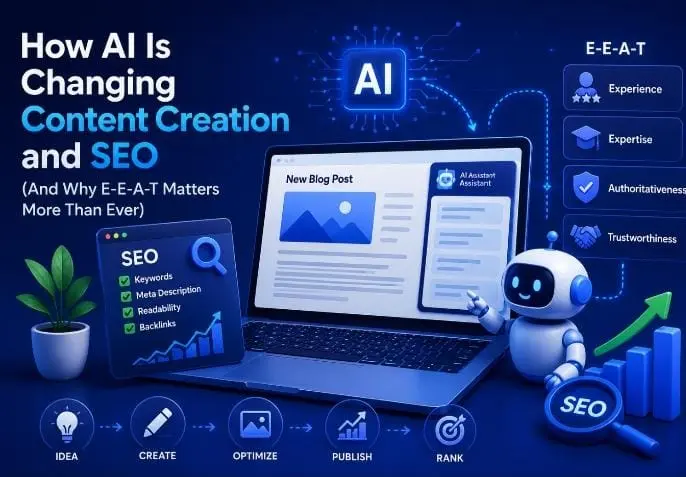
How AI Is Changing Content Creation and SEO (And Why E-E-A-T Matters More Than Ever)
I still remember watching someone generate a “complete blog post” in under a minute and just publish it. No edits, no second read, straight to the CMS. That was maybe two years ago, and it felt like a neat party trick. Now it’s basically the default workflow for half the internet, and you can tell.
AI has changed content creation faster than almost anything I’ve seen in this industry, and Google has been scrambling to keep up. If that acronym isn’t already part of your content strategy in 2026, your competitors probably already figured this out. Let’s get into what’s actually different, and what to do about it.
Everyone Can Write Now. That's the Problem.
Here’s the thing nobody wants to say out loud: AI made content basically free to produce. You want a 2,000-word article on “best running shoes for flat feet”? Ninety seconds, done. Sounds amazing until you remember every competitor, blogger, and affiliate site figured out the same trick.
So now the internet is buried under content that all sounds the same. Same five subheadings. Same “in conclusion” wrap-up. Same vaguely helpful but oddly hollow advice. Search engines picked up on this before most marketers did, and they’ve been ruthless about it.
Google’s Helpful Content Update, and the core updates that followed, weren’t really an attack on AI itself. They were going after thin, low-value content — it just so happened that a huge chunk of that content was AI-written, because AI made churning it out so painfully easy.
Okay, So What Actually Is E-E-A-T?
Experience, Expertise, Authoritativeness, Trustworthiness. Google tacked on that extra “E” for Experience back in late 2022, and it’s become arguably the most important letter of the four.
Think about it. An AI model can write a paragraph about what it’s like to run a marathon. It’ll pull phrases from a thousand runner blogs and stitch together something that reads convincingly. But it’s never actually run one, never felt its knees give out around mile 20. It’s guessing based on other people’s real experiences, dressed up as its own.How AI Is Changing Content Creation and SEO (And Why E-E-A-T Matters More Than Ever)
Quick breakdown, in plain terms:
- Experience — Did you actually do this thing, use this product, live through this situation?
- Expertise — Do you know what you’re talking about, credentials or not?
- Authoritativeness — Do other people (and sites) already treat you as a trusted source?
- Trustworthiness — Is this accurate, transparent, and not trying to manipulate anyone?
Where AI Genuinely Earns Its Keep
I’m not here to tell you AI is the enemy. Used right, it’s one of the best productivity boosts content teams have had in a decade.How AI Is Changing Content Creation and SEO (And Why E-E-A-T Matters More Than Ever)
Research and outlining, for one. Feed it a messy pile of notes and it hands back something structured in minutes — work that used to eat an entire morning.
Repurposing, too. Turning one long guide into five LinkedIn posts, a script, and an email sequence used to be a full day’s grind. Now it’s an afternoon, if that.
First drafts, too, when you’re honest about what they are: a starting point, not a finish line. A rough AI draft, torn apart and rebuilt by someone who actually knows the subject, tends to beat staring at a blank page for an hour.
And it’s genuinely good at pattern-spotting — scanning competitor content, flagging gaps, surfacing the questions people are actually typing into Google.
None of that is the problem. The problem is when people skip the “torn apart and rebuilt” part and just… hit publish.
.
Where It Falls Apart (And Google Notices)
AI content has tells. Search engines are getting better at spotting them, and honestly, so are readers.How AI Is Changing Content Creation and SEO (And Why E-E-A-T Matters More Than Ever)
Generic advice that could apply to literally anyone, anywhere, with zero specific numbers or “here’s what actually happened when I tried this.” Confident wrongness — the well-documented hallucination problem, where the model states something false with total conviction and no hesitation. A weird flatness where nothing sounds like an opinion, because the model’s trained to hedge and stay safe, which also makes it forgettable. And often, just… nothing new. No original data, no fresh insight, just a remix of the top ten articles already ranking for that keyword.How AI Is Changing Content Creation and SEO (And Why E-E-A-T Matters More Than Ever)
None of this means AI-assisted content automatically ranks poorly. It means content that sounds like it came from nowhere in particular tends to underperform — and unedited AI output falls into that trap constantly.
So What Do You Actually Do Differently?
.
Lead with real experience. Screenshots, actual results, photos you took yourself, specific stories with specific details. Tested a product? Say what happened, including the part that didn’t work. Ran a campaign? Share the real numbers, even the underwhelming ones.
Put an actual human name on it. Author bios with real credentials carry more weight now, not less. “Written by AI,” or worse, no byline at all, does nothing for anyone’s trust. A quote from your actual head of marketing does a lot more heavy lifting than you’d think.
Treat AI like a co-pilot, not the pilot. Let it draft. Let it brainstorm. Don’t let it publish unsupervised. Every AI-assisted draft needs a human pass that adds specificity, fixes the wrong bits, and puts an actual opinion in there somewhere.
Go deep, not wide. Google increasingly favors sites that really know one thing over sites that vaguely cover everything. Ten thorough, experience-backed pieces on a single topic will usually beat a hundred shallow ones scattered across your whole niche.
Check your facts. Actually check them. If AI handed you a stat, a date, a claim — verify it before it goes live. Trust is the easiest of the four E’s to lose and probably the hardest to earn back.
Link to your sources. Cite real studies, quote actual experts, show where your numbers came from. It signals honesty to readers and, increasingly, to the algorithms judging you.
Search Itself Is Shifting Underneath Us
Zoom out for a second. AI Overviews and answer engines now summarize information right in the search results, before anyone clicks through. Plain, generic informational content gets squeezed hardest here, because a summary can already give someone that.
What still earns a click is what a summary can’t replicate — a real opinion, an actual test you ran, some nuance that only comes from someone who’s genuinely done the thing. It’s a strange twist: the more human your content feels, the more future-proof it becomes. Not because AI is disappearing, but because it flooded the market with sameness, and sameness is now the cheapest thing on the internet.
Bottom Line
AI didn’t kill good content. It killed lazy content, and honestly, it was overdue. The bar for “genuinely helpful” went up, not down, because suddenly everyone could produce something that looked helpful on the surface.
If you want your content to actually rank, and actually matter to the person reading it, the formula hasn’t changed much: real experience, real expertise, real trust. AI can get you there faster. It just can’t get you there by itself.